
Startup Funding Brief · October 9, 2026 · 5 min read
Hardware Intelligence and Deep Tech Draw Serious Capital This Week
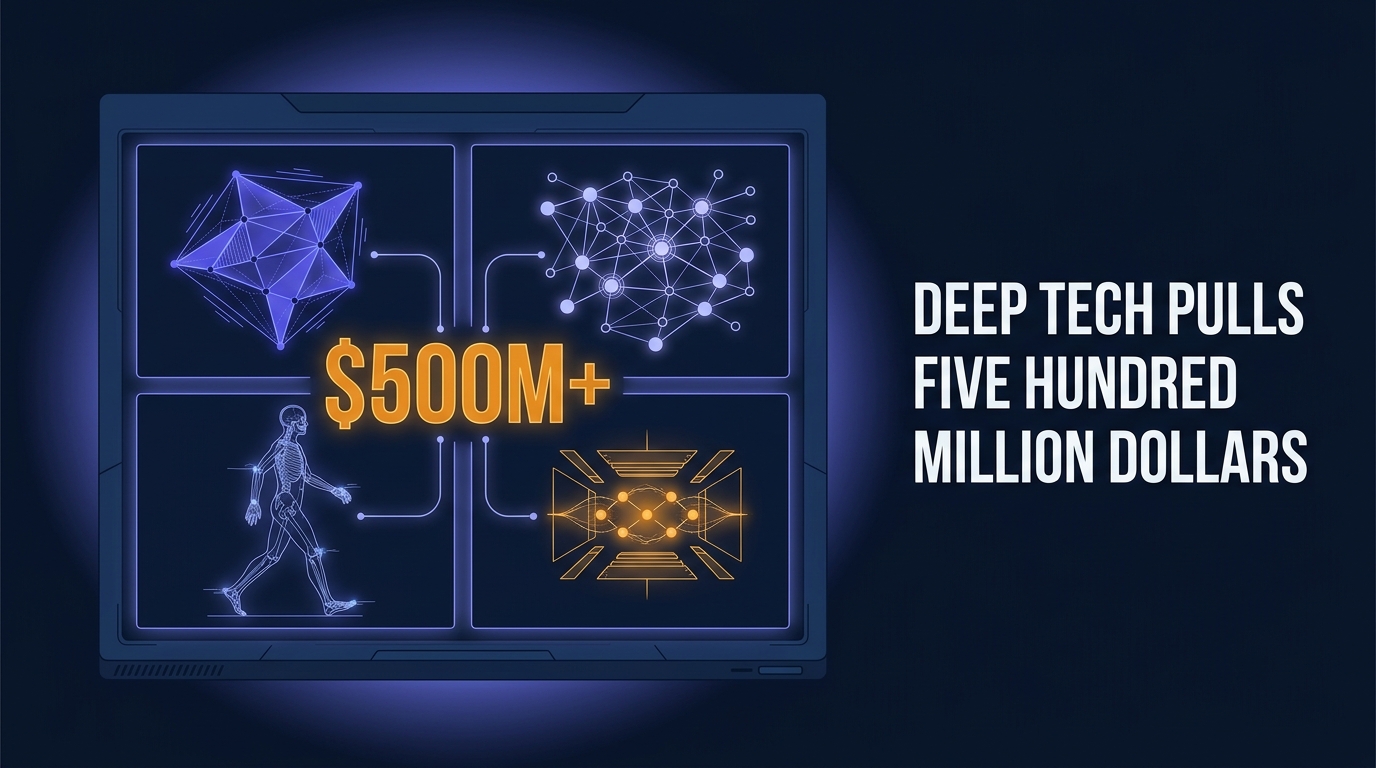
Four deals totaling over $500M signal that institutional investors are concentrating bets on hardware simulation, AI agents, robotics data, and quantum computing in Q4 2026.
Hardware simulation reaches unicorn status
Vinci4D closed a $250M Series B at a $1.5B valuation, as both Advent International and SiliconANGLE reported [1][2]. The round was co-led by Advent, Temasek, and Xora, with AMD Ventures, Khosla Ventures, Eclipse, and Madrona also participating. That syndicate — mixing growth equity firms, a sovereign wealth fund, and strategic chip-industry capital — is worth noting on its own.
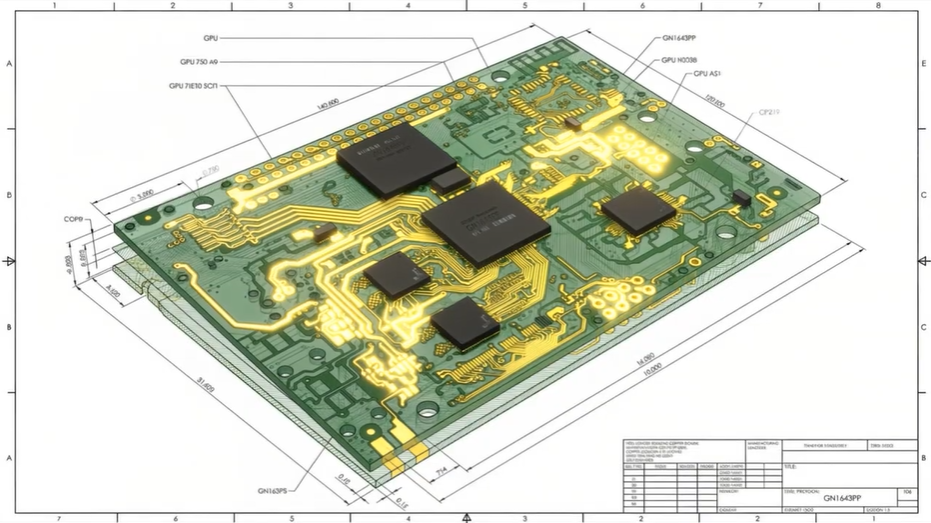
The company builds simulation software for hardware engineers: tools that let designers test how a product behaves under real-world conditions before a physical prototype exists. The pitch is compressing the time between concept and manufacturable design. At $1.5B, investors are pricing in the possibility that simulation becomes a standard layer in hardware development pipelines across automotive, aerospace, and semiconductors.
For founders in the industrial software or applied AI space, this deal sets a comp. A B-round at six times the Series A valuation is unusual outside of AI infrastructure right now. It also confirms that deep-pocketed strategic investors — AMD Ventures in this case — are willing to write checks into platforms that could become dependencies for their own customers.
Strategic corporate investors are picking AI agent winners early
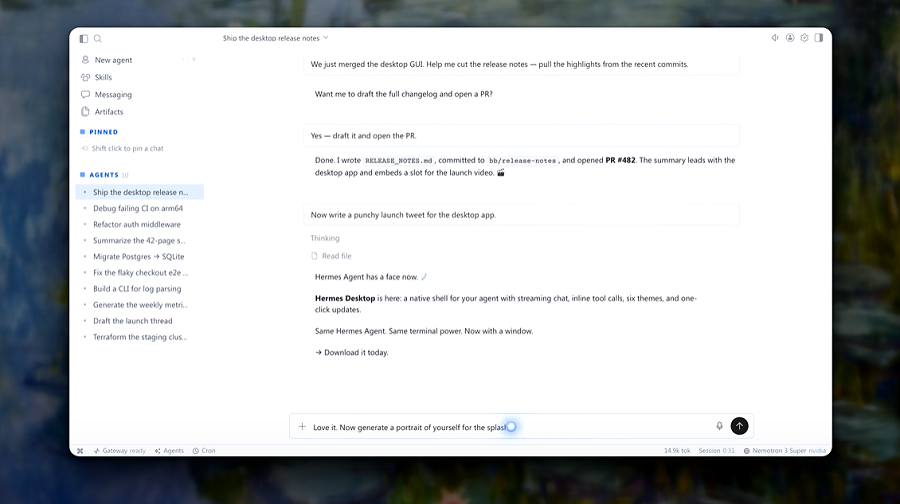
Nous Research, the company behind the Hermes AI agent, raised $90M in a Series B led by Robot Ventures and backed by Nvidia, Samsung, and Y Combinator, according to SiliconANGLE [3]. The startup is now valued at $1.5B — the same headline valuation as Vinci despite a significantly smaller round, implying a much higher revenue multiple or a stronger growth narrative.
The Nvidia and Samsung participation is the signal worth tracking. Both companies have obvious distribution leverage over AI agent adoption: Nvidia through its developer ecosystem, Samsung through consumer and enterprise hardware. When corporates at that scale join a Series B rather than waiting for a later stage, they are usually securing early access or influence, not just financial return.
Founders building in the AI agent layer should take note of the dynamic: strategic capital from infrastructure incumbents is moving earlier than it has historically. That creates both an opportunity — faster paths to partnership and distribution — and a risk, since taking strategic money can complicate later rounds or an eventual exit.
Robotics data infrastructure attracts top-tier generalist funds
Mecka AI, which collects and analyzes human motion data to train humanoid and other robots, announced a $60M Series B led by Sequoia, with Nvidia and Microsoft's M12 fund also participating, as TechCrunch reported [4]. The round values the company at approximately $500M.
The Sequoia lead matters here more than the dollar amount. Generalist tier-one funds have historically been cautious about robotics data companies, preferring to invest in the robots themselves or the software that runs them. Sequoia anchoring a round for a data infrastructure play suggests the category is maturing enough that raw training data has become a distinct, defensible business rather than a feature inside a larger platform.
The co-investment from Nvidia again — appearing in both this deal and the Nous Research round in the same week — reinforces a pattern. Nvidia is acting as an active investor across the AI stack: agents, simulation, and now robot training data. Founders pitching anything that could accelerate GPU utilization or expand the market for compute should factor this into their investor targeting.
Quantum computing logs its largest ever Series A
Universal Quantum announced it has raised over $100M in a Series A, which it describes as the largest Series A ever raised by a quantum computing company, according to its announcement [5]. The round was backed by sovereign funds, institutional investors, and quantum-specialist investors. The company focuses on trapped-ion systems and is based across Haywards Heath and Hamburg.
The Series A label on a $100M+ round is unusual — most companies at that capital level are closing B or C rounds. It reflects the long development timelines in quantum hardware, where companies remain pre-revenue or pre-scale for far longer than software startups. The presence of sovereign wealth funds in the syndicate is consistent with that: patient capital willing to hold through a decade-long commercialization curve.
For most founders reading this brief, quantum is not immediately actionable. But the size of this round is a useful data point about what 'deep tech patient capital' looks like in 2026: nine figures at Series A, sovereign-backed, and still years from broad commercial deployment. If you are building in quantum or another long-cycle hardware category, this round confirms the capital exists — but it also clarifies what kind of investor you need to find.
What this week's deals mean for your raise
Taken together, these four deals point to a specific kind of investor appetite right now: infrastructure that accelerates hardware development, AI capabilities with clear distribution paths, and physical-world data that trains autonomous systems. Pure software plays without a hardware or physical-world angle are not what these syndicates are chasing.
The recurring presence of Nvidia across multiple deals this week is not coincidental. Strategic investors tied to compute infrastructure are writing checks earlier and more broadly than in prior cycles. For founders who can credibly argue their product expands the market for AI compute — whether through simulation, agent deployment, or robot training — that is a real opening in the current environment.
This week, if you are raising
- If your startup sits in hardware simulation, robotics data, or AI agent infrastructure, map this week's active investors — Advent, Temasek, Sequoia, Robot Ventures, Nvidia Ventures, M12 — and check whether your round size and stage align with where they are actually writing checks.
- Corporate strategic investors like Nvidia and Samsung are entering rounds earlier than usual, so if your product expands AI compute demand or fits their ecosystem, pursue a strategic conversation before your round closes rather than after.
- If you are raising for a long-cycle deep tech category, Universal Quantum's $100M+ Series A confirms sovereign and specialist funds will write large early checks — research which sovereign wealth funds and deep tech specialists participated and whether they have mandates that match your geography and sector.
Sources
 [1]Vinci raises $250M Series B at $1.5B valuation to build the intelligence infrastructure for a new era of hardware engineering — Advent Internationaladventinternational.com
 [2]Vinci reels in $250M for its engineering simulation platform - SiliconANGLEsiliconangle.com
 [3]Nvidia, Samsung back $90M round for AI agent startup Nous Research - SiliconANGLEsiliconangle.com
- [4]Robot data startup Mecka AI nabs $60M from Sequoia | TechCrunchtechcrunch.com
- [5]Universal Quantum raises over $100m Series A to scale quantum computing globally | Universal Quantumuniversalquantum.com