
Startup Funding Brief · November 17, 2026 · 4 min read
Dreamteam's $53M Bet That AI Can Finally Crack the CRM Market
A new AI-native CRM backed by Accel and Together Fund joins a thickening field of challengers targeting Salesforce's enterprise grip, just as a valuation milestone in cybersecurity AI shows how fast institutional capital is moving.
Former Freshworks Hands Take Their Shot
Dreamteam, founded by former Freshworks executives, closed $53 million across a seed and a Series A to build an AI-native CRM positioned against both Salesforce and HubSpot, as TechCrunch reported [2]. Together Fund led the seed tranche and Accel led the Series A, a structure that is worth noting: rather than staging each round separately, the company stacked both closes in a single announcement, suggesting the founding team moved quickly from initial conviction to growth-stage capital.
The strategic logic is familiar — incumbent CRMs carry years of technical debt and pricing complexity — but the founders are betting that building AI into the product's core architecture from day one, rather than bolting it on, is the differentiator that earlier challengers lacked. Whether that thesis holds will depend heavily on enterprise sales cycles, which rarely move at seed-round speed.
A Crowded Attack on the Same Incumbent
On the same day, Lightfield announced an enterprise tier for its own Salesforce alternative, adding single sign-on, SCIM provisioning, granular permissions, and two-way Salesforce data sync [1]. The company is backing its offer with a performance guarantee: migrations complete in 30 days or the customer does not pay until the agreed scope is delivered. That kind of contractual commitment is unusual at an early stage and signals confidence in repeatable process over product alone.
Two CRM challengers making significant moves in a single news cycle is not coincidence. It reflects a broadly shared investor view that the enterprise CRM category is ripe for disruption — and that AI gives new entrants a credible technical wedge. For founders raising in horizontal SaaS or vertical software this quarter, that consensus is a double-edged signal: the opportunity looks real, but the competitive field is filling up faster than the sales cycles that will ultimately decide the winners.
Three Months to a Billion: What Corma Signals
Separately, TechCrunch reported that cybersecurity AI startup Corma reached a $1 billion valuation in roughly three months [4]. The outlet did not provide full round details in the available summary, so the precise investors and structure are not known from these items. What is clear is the timeline: a unicorn milestone in a quarter is an outlier by any historical measure.
For founders raising in AI security or adjacent infrastructure categories, Corma's trajectory illustrates that institutional investors are willing to price speed-of-traction very aggressively right now. It also raises the bar for what a compelling narrative looks like in those categories — a team that cannot point to rapid, measurable customer uptake will find the valuation conversation harder, not easier, in this environment.
Hardware Rounds at Opposite Ends of the Scale
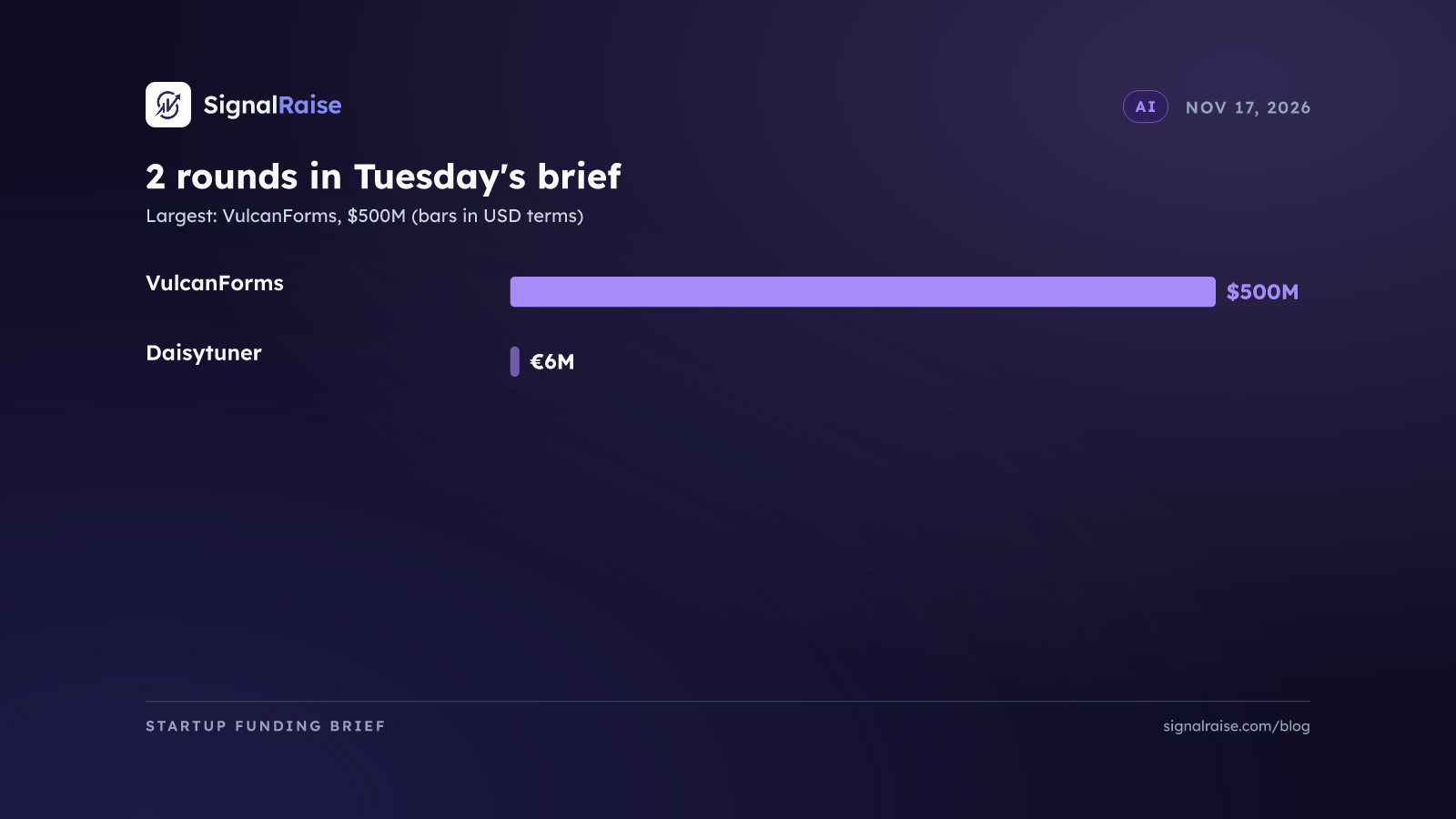
VulcanForms secured $500 million in financing led by J.P. Morgan and funds managed by Apollo to build three new metal additive manufacturing factories in the United States, adding to three plants the company already operates in Massachusetts, as VoxelMatters reported [3]. The round is explicitly tied to multibillion-dollar commercial programs the company said are driving demand. This is late-stage industrial capital, not venture: the involvement of J.P. Morgan and Apollo signals that the company has moved beyond proof-of-concept into infrastructure buildout backed by contracted revenue.
At the other end of the scale, Darmstadt-based Daisytuner raised €6 million in a seed round co-led by Elaia and LEA Ventures, with participation from the Amadeus APEX Technology Fund and Seedcamp, to develop its Daisyflow AI inference engine for enterprise hardware [5]. Founded in 2024, the company is targeting the gap between model capability and efficient deployment on existing corporate infrastructure — a problem that has real urgency as enterprises try to run AI workloads without replacing their hardware fleets. The two rounds are unrelated in sector and stage, but together they illustrate that capital is flowing into physical and near-physical infrastructure on both ends of the maturity curve.
This week, if you are raising
- If you are raising in horizontal SaaS with an AI-native architecture, sharpen your differentiation story now — Dreamteam's $53M close means investors will ask how your approach differs from at least two well-funded CRM challengers already in the market [2].
- Corma's path to a $1B valuation in roughly three months suggests investors in AI security are rewarding demonstrated traction at an unusually compressed pace — if you are in that category, prioritize metrics that show speed of customer adoption over breadth of product vision [4].
- Lightfield's performance-backed migration guarantee shows that de-risking the switching cost — not just the product — is becoming a competitive requirement in enterprise software; consider whether your own onboarding terms can be structured to remove a buyer's biggest objection before the sales conversation starts [1].
Sources
[1]Lightfield launches an enterprise-ready alternative toglobenewswire.com
 [2]Freshworks alums raise $53M to take on Salesforce, HubSpot with AI-native CRM | TechCrunchtechcrunch.com
 [3]VulcanForms raises $500 million to build three new US factories | VoxelMatters - The heart of additive manufacturingvoxelmatters.com
 [4]November 16, 2026 | TechCrunchtechcrunch.com
 [5]German DeepTech Startup Daisytuner Raises €6 Million to Scale AI Inference Engine Across Enterprise Hardware - EU Startups Newseustartups.news