
Startup Funding Brief · September 26, 2026 · 4 min read
Defense drones, AI tools, and vertical agents pull in capital this week
Five rounds across defense tech, AI software, materials science, legal agents, and data center hardware reveal where investors are placing concentrated bets this quarter.
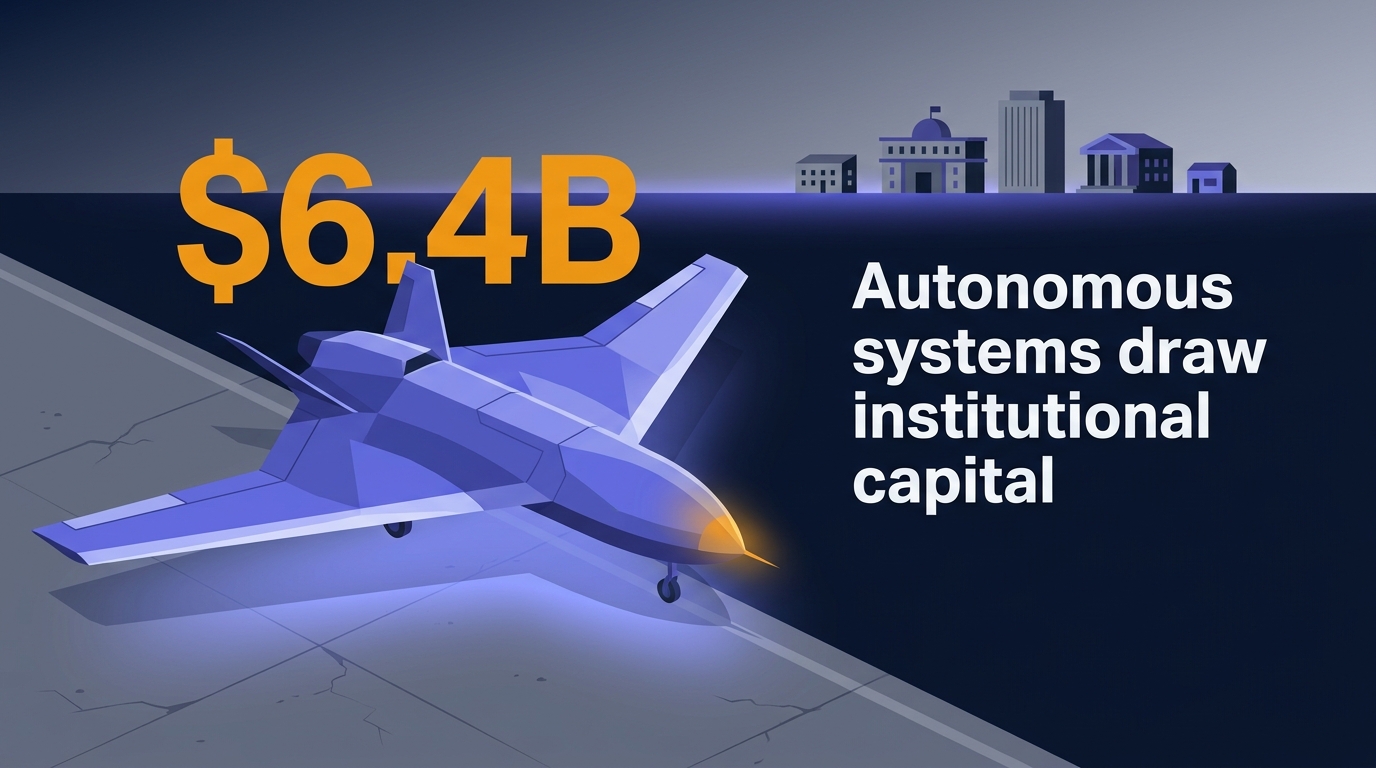
A $6.4B defense drone milestone
TEKEVER, the Portuguese-founded autonomous systems company, closed the first tranche of a $580 million Series D this week at a $6.4 billion valuation, as tech.eu reported [1]. Backers UC Investments and Baillie Gifford led the round — institutional names more associated with long-horizon, large-cap positions than early venture. That choice of capital source matters as much as the number itself.
The timing is tied directly to contract momentum. TEKEVER had recently been selected for the British Army's £400 million CORVUS programme, giving investors a visible government revenue anchor rather than a speculative pipeline [1]. For founders building in defense or dual-use autonomy, the sequence here is instructive: a major government contract preceded — and almost certainly enabled — a raise at this scale and valuation.
What remains unclear from available reporting is the breakdown between new and existing investors in this first close, or how the remaining capital in the round will be deployed. Still, the signal is clear: autonomous systems with verified government contracts are attracting institutional capital that rarely touches early-stage defense at all.
AI software revenue is scaling at unusual speed
Lovable, the vibe-coding platform, crossed $600 million in annualized revenue as of this week — up from roughly $500 million just three months ago, according to TechCrunch [2]. Co-founder Fabian Hedin shared the figure at the HumanX summit in Amsterdam. The pace of that increment, $100 million in annualized revenue added in a single quarter, is not typical SaaS growth.
Two-thirds of Fortune 500 companies are now reportedly using Lovable's product, with its co-founder citing a deliberate push into enterprise as the driver [2]. The enterprise angle is relevant for founders to read carefully: consumer-led AI tools that find a path into organizational workflows are commanding a different valuation multiple than pure consumer plays. How Lovable converts usage into durable contract revenue will determine whether this trajectory holds, but that detail is not yet public.
AI-directed labs compress research timelines
Cambridge-based Lila Sciences published results from an AI-directed laboratory effort that screened 2,942 catalysts for green hydrogen production in three months, identifying six high-performing material families, as Lila reported [3]. The work was done autonomously — the AI system proposed, synthesized, and evaluated candidates without researchers selecting which experiments to run.
The significance for startup funding is structural, not just scientific. Materials discovery and wet-lab research have historically been too slow and capital-intensive to attract venture timelines. If autonomous lab platforms can compress multi-year discovery cycles into quarters, the category becomes fundable on conventional venture schedules. Founders working in biotech, chemistry, or energy materials now have a concrete benchmark to reference when explaining their own R&D velocity to investors [3].
Two rounds show what vertical AI traction looks like
Chamelio raised $26 million in a Series A led by Entrée Capital, with Work-Bench, Emerge Ventures, and Bright Pixel Capital also participating — just five months after its seed round closed, as Tech Startups reported [4]. The company builds AI legal agents, and its annual recurring revenue quadrupled over that five-month window. The gap between seed and Series A is compressing when revenue data is this sharp.
PicoJool announced a $27.5 million Series A led by Socratic Partners, with Hudson River Trading joining, for optical connectivity hardware aimed at AI data center infrastructure [5]. The round follows a $12 million seed led by Playground Global, bringing total funding to $39.5 million. Hudson River Trading's participation is worth noting — trading firms investing in infrastructure hardware signals that AI compute demand is being felt by organizations that depend on low-latency, high-throughput systems professionally.
Together, these two rounds illustrate a pattern visible across this week's activity: investors are backing AI applications and infrastructure where the customer pain is specific, measurable, and already generating revenue. Chamelio's legal agents and PicoJool's optical interconnects both serve concentrated, high-value buyer segments — law firms and data center operators — rather than broad horizontal markets [4][5].
This week, if you are raising
- If you are raising in defense or dual-use autonomy, document government contract wins or LOIs before approaching institutional investors — TEKEVER's £400M CORVUS selection visibly preceded its $580M round [1].
- Chamelio's seed-to-Series A in five months was driven by ARR quadrupling — quantify your revenue growth rate as a multiple over a specific time period, not just as an absolute number, when speaking with investors [4].
- Vertical AI agents and AI infrastructure hardware are both closing rounds this week; if your startup fits either category, sharpen your answer to one question: what is the measurable cost or time your product removes from a specific, named buyer's workflow [4][5].
Sources
 [1]TEKEVER raises $580M Series D at $6.4B valuation - Tech.eutech.eu
 [2]Lovable's annualized revenue crosses $600M as vibe coding takes off | TechCrunchtechcrunch.com
- [3]How an AI-run lab cracked open green hydrogen's catalyst problem | Lilalila.ai
 [4]Chamelio raises $26M Series A for AI legal agents as ARR quadruples in five months - Tech Startupstechstartups.com
 [5]PicoJool Announces $27.5M Series A to Scale Optical Connectivity for AI Infrastructuretheaiinsider.tech