
Startup Funding Brief · October 14, 2026 · 4 min read
AI Startup Funding Hits New Extremes Across Every Stage
From a $60M seed round closed in five months to an $870M Series A, this week's deals reveal a market where conviction capital is compressing timelines and inflating benchmarks at every stage.
Seed rounds that look like Series B
Hone, a startup that is just five months old, closed a $60 million seed round led by Benchmark and Index Ventures at a $285 million valuation, as Dealroom reported [3]. The company was founded by alumni of Signal Copilot and Cognition AI and is building what it calls Engines — persistent AI systems assigned goals rather than individual tasks. The pitch is not another chatbot wrapper; it is AI that, in the words of its CEO, owns outcomes.
For founders raising at pre-seed or seed right now, this deal sets an uncomfortable benchmark. A $285 million seed valuation is not the norm, and founders who use it as a comparable risk losing credibility with investors doing careful diligence. What it does signal is that pedigree and a clearly differentiated positioning in the autonomous-agent category can unlock capital at a pace and scale that would have been unthinkable two years ago. If your founding team does not carry that profile, expect a more conventional process.
Series A resets what mega-round means
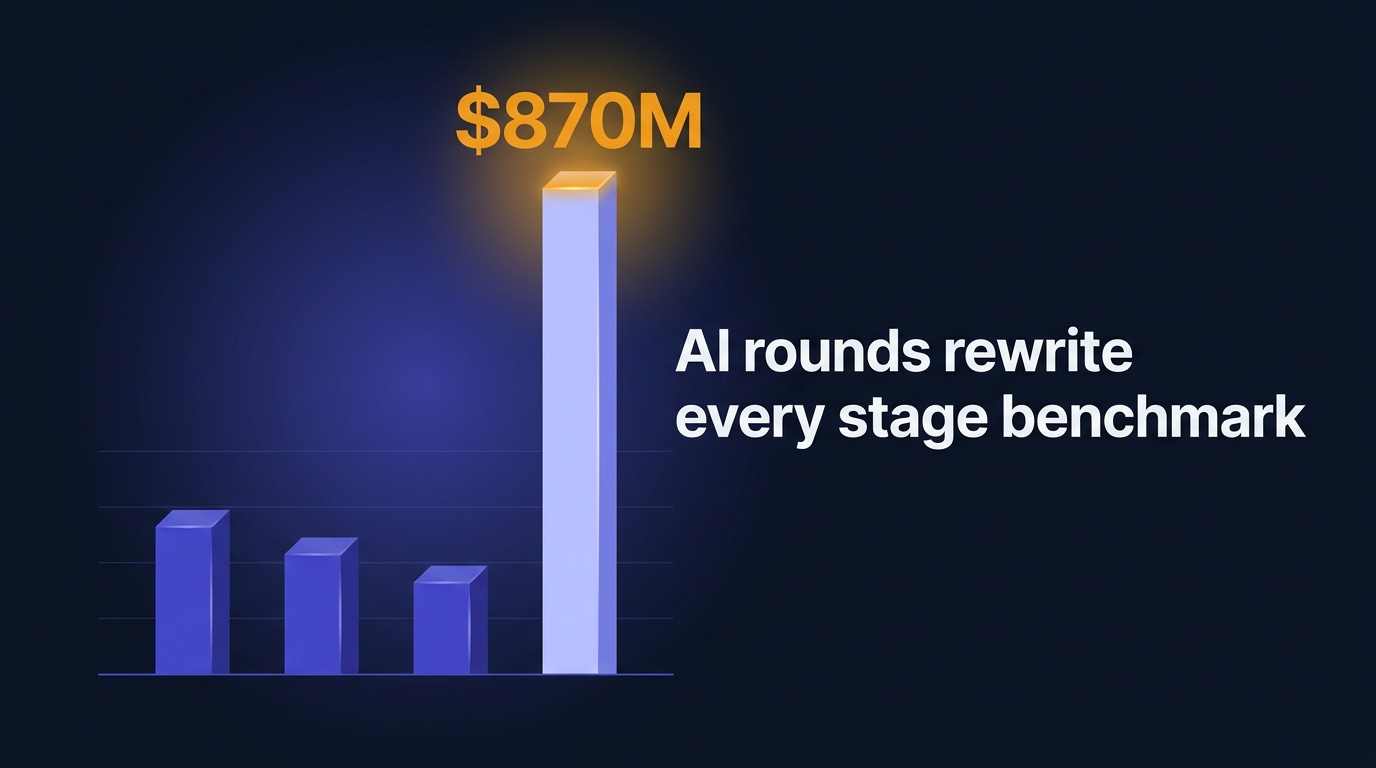
TypeSafe AI closed an $870 million Series A led by Andreessen Horowitz at a $7.5 billion valuation, just three weeks after launching a new AI decision model, as Tech Company News reported [1]. Sequoia Capital and existing investor DCVC also participated. A Series A at that scale is not a financing event in the traditional sense — it is a land-grab play, and the speed from launch to close suggests a16z and Sequoia moved with competitive urgency.
The practical implication for founders raising a standard Series A of $10–25 million is that these headline numbers will distort perception without necessarily changing the terms available to them. Investors writing normal-sized Series A checks are not suddenly competing with a16z for those deals. What does shift is the narrative pressure: investors will ask more pointed questions about why your category is defensible against well-capitalized players who can move this fast.
Vertical AI earns its own valuation logic
Albert Invent raised a $55 million Series B led by TCV at a $340 million valuation, as AI Weekly reported [4]. Its Valence model was trained on 15 million molecules and the full chemical patent corpus, and the company claims it is 45 times more accurate than general-purpose AI on chemistry tasks. Customers include BASF, Henkel, Clorox, Kenvue, and AkzoNobel, and the CEO stated that 30 percent of chemistry work at some customers already runs through the platform.
This deal is a useful data point for any founder building domain-specific AI rather than horizontal tooling. A proprietary dataset, a measurable accuracy advantage over general models, and a named enterprise customer list appear to be the three ingredients TCV needed to lead at this valuation. Founders in regulated or technically dense verticals — materials science, drug discovery, industrial engineering — should note that the market is willing to pay for specificity when you can quantify it.
Infrastructure capital dwarfs everything else
Broadcom, Apollo, and Blackstone announced a $35 billion partnership to expand AI computing infrastructure, focused on next-generation data center capacity, as CNNBC reported [2]. At the same time, former Slack executives Noah Desai Weiss and Dolapo Falola raised $34 million from Accel and IVP for Scuba, a context engine designed to help teams and AI agents share institutional knowledge, as reported by Aventure.vc [5].
These two deals sit at opposite ends of the capital stack but point at the same problem: AI systems are being deployed faster than the infrastructure and organizational fabric required to support them. The $35 billion bet is on compute; the $34 million bet is on context. For founders building in the coordination, memory, or tooling layer around AI agents, the Scuba raise suggests there is genuine early-stage appetite for that problem, particularly when the founding team has direct operational experience scaling collaboration software.
This week, if you are raising
- If you are raising a seed round, calibrate your valuation conversation to your team's provable technical depth and customer traction — not to Hone's $285 million benchmark, which reflects a rare combination of pedigree and timing [3].
- Vertical AI founders should quantify their accuracy or efficiency advantage over general-purpose models in concrete terms before investor meetings, using customer data wherever possible, as Albert Invent's 45x accuracy claim and named enterprise roster appear to have been central to closing a TCV-led round [4].
- If your product sits in the AI agent infrastructure or coordination layer, the Scuba raise confirms that top-tier VCs are actively writing checks in this space, so sharpen your explanation of what specifically breaks without your product when AI agents are deployed at scale [5].
Sources
 [1]TypeSafe AI Raises $870 Million In Series A Funding Round - Tech Company Newstechcompanynews.com
- [2]Broadcom, Apollo and Blackstone Launch $35 Billion Artificial Intelligence Infrastructure Venture - CNNBCcnnbc.com
 [3]Hone raises $60M seed to build AI that owns business outcomes | Dealroom Newsdealroom.co
- [4]Albert Invent lands $55M Series B led by TCV at $340M valuation | AI Weeklyaiweekly.co
- [5]Exclusive: Slack Alums Launch Scuba, New ‘Context Engine’ For Teams And AI Agentsaventure.vc