
Startup Funding Brief · October 16, 2026 · 5 min read
AI Infrastructure Capital Floods In While Niche Models Win Deals
This week's rounds reveal a market splitting into two lanes: multi-billion-dollar bets on raw compute capacity and disciplined capital flowing to AI built for specific industries.
Mega-Capital Is Reshaping the Infrastructure Floor
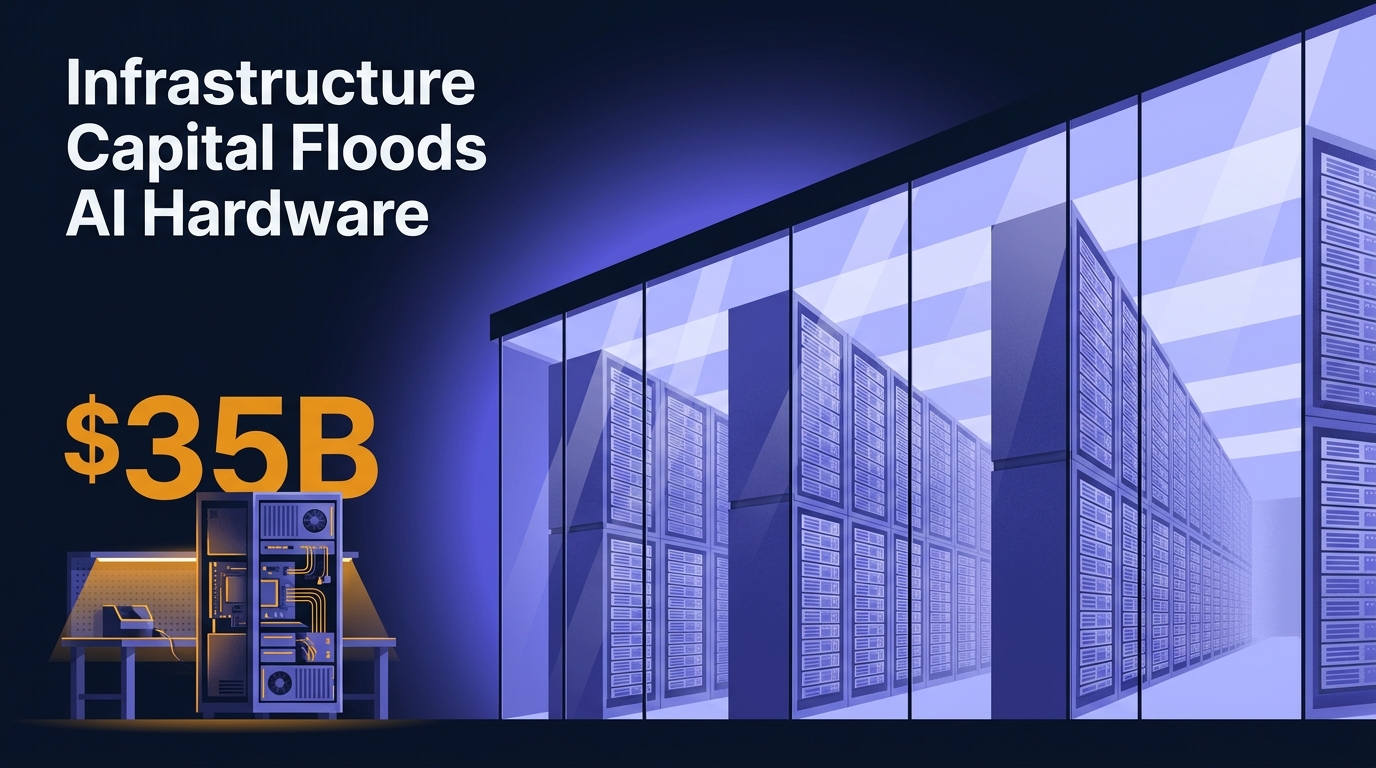
The numbers at the infrastructure layer are no longer legible as venture rounds. As reported by CNNBC, Broadcom, Apollo, and Blackstone have formed a $35 billion partnership aimed at expanding advanced AI computing capacity and building out next-generation data centers [2]. This is not a startup bet — it is a structural commitment by hardware, private equity, and alternative asset players to own the physical layer of AI for the next decade.
Oxide Computer, an Emeryville company that manufactures rack-scale cloud computers for corporate and government data centers, raised $445 million in a Series D led by Eclipse, according to Hoodline [5]. The company says demand is already outrunning its manufacturing capacity even after a major production scale-up over the past year. That constraint — too many orders, too few machines — is the kind of problem that attracts large capital quickly, and it did.
For founders raising at pre-seed or seed, these rounds are context, not competition. What they signal is that enterprise buyers — particularly in regulated sectors — are actively procuring compute infrastructure. If your product sits on or near that layer, the customer urgency is real and growing.
Series A Valuation Benchmarks Are Being Reset at the Top
TypeSafe AI closed an $870 million Series A at a $7.5 billion valuation, led by Andreessen Horowitz with participation from Sequoia Capital and DCVC, as Tech Company News reported [1]. The round came just three weeks after the company launched what it describes as a non-text decision model. The speed between launch and close — and the size of the outcome — reflects how quickly conviction is forming around new AI model categories when a lead investor decides to move.
This round will influence how founders and investors discuss Series A pricing for the next two quarters. An $870 million Series A is not a benchmark most companies will reach, but the valuation logic — that a differentiated model architecture can command a billion-dollar-range entry — does filter down into how term sheets get negotiated across the market. Expect investors at smaller check sizes to reference this round when founders push on valuation.
Domain-Specific AI Is Closing Real Rounds at Real Valuations
The more actionable signal for most founders this week comes from Albert Invent, which raised a $55 million Series B led by TCV at a $340 million valuation, as AI Weekly reported [3]. Albert Invent builds AI for chemistry and materials science: its Valence model was trained on 15 million molecules and the full chemical patent corpus, and the company claims it is 45 times more accurate than general-purpose AI for chemistry tasks. Customers include BASF, Henkel, Clorox, Kenvue, and AkzoNobel.
The Albert Invent round is a clean example of what is working in enterprise AI right now: a model trained on domain-specific data, sold to named customers in a single industry, with a measurable accuracy claim versus a general alternative. None of those elements are accidental. TCV led at a valuation that implies roughly six times the round size — a multiple that reflects recurring revenue and customer quality, not speculation.
The lesson for founders is structural. General-purpose AI positioning is increasingly difficult to finance at the seed and Series A stage, while vertical specificity — genuine training data advantages, measurable performance gaps, and referenceable enterprise customers — continues to attract institutional capital.
AI Agent Infrastructure Is an Early but Funded Bet
Scuba, a startup founded by two former Slack executives, raised $34 million from Accel, IVP, and a group of startup CEOs including Stripe's Patrick Collison, as reported by Aventure.vc [4]. The company is building what it calls a context engine — infrastructure designed to give AI agents and human teams access to the institutional knowledge and working style of an organization, which Scuba's founders refer to as capturing organizational "taste."
The round is notable for two reasons. First, the check size and investor quality signal that agent infrastructure is being treated as a serious category, not a feature. Second, the founding team's background matters here: people who built communication tools at Slack at scale have direct insight into where AI agents break down in real team environments. That founder-problem fit is the kind of thing that unlocks conviction from top-tier funds at an early stage when the product is still forming.
What is not yet clear from the reporting is whether Scuba has paying customers or is pre-revenue. For founders evaluating how to position comparable plays, that distinction will matter significantly when they reach their own conversations with investors.
This week, if you are raising
- If you are building AI for a specific industry, identify one measurable performance claim against a general-purpose alternative and lead with it in every investor conversation this week — Albert Invent's 45x accuracy framing is the kind of anchor that drives conviction.
- Review whether your deck addresses compute access and infrastructure costs directly: with $35 billion moving into AI infrastructure and Oxide's supply constraints in the news, investors are asking hard questions about how AI startups will access capacity at scale [2][5].
- If you are raising a Series A and your round is below $50 million, prepare a clear answer for why your valuation is appropriate given the TypeSafe AI benchmark — investors will raise it, and having a grounded, specific response protects your negotiating position [1].
Sources
 [1]TypeSafe AI Raises $870 Million In Series A Funding Round - Tech Company Newstechcompanynews.com
- [2]Broadcom, Apollo and Blackstone Launch $35 Billion Artificial Intelligence Infrastructure Venture - CNNBCcnnbc.com
- [3]Albert Invent lands $55M Series B led by TCV at $340M valuation | AI Weeklyaiweekly.co
- [4]Exclusive: Slack Alums Launch Scuba, New ‘Context Engine’ For Teams And AI Agentsaventure.vc
 [5]Oxide Computer Raises $445M Series D in Emeryvillehoodline.com