
Startup Funding Brief · October 13, 2026 · 4 min read
AI Infrastructure Bets Dwarf Early-Stage Rounds This Week
From a $60M seed at five months old to a $35B infrastructure joint venture, this week's deals reveal a market placing extreme premiums on AI conviction at every stage.
A $60M Seed Round Resets Expectations
Hone, a startup that is five months old and staffed by veterans of Signal Copilot and Cognition AI, closed a $60 million seed round led by Benchmark and Index Ventures, as Dealroom reported [1]. The post-money valuation landed at $285 million — before the company has shipped a product to market at scale.
What Hone is building matters for how investors are thinking right now. Rather than AI that executes discrete tasks, the company is developing what it calls Engines: persistent AI systems assigned to own goals over time. The framing is a direct signal that investor appetite has moved past chatbots and copilots toward autonomous agents that take responsibility for outcomes.
For founders raising a pre-seed or seed this quarter, the Hone round is a double-edged data point. It shows that checks of extraordinary size are available — but they are flowing to teams with specific pedigree and a differentiated technical thesis, not to AI-wrapper businesses. The valuation multiple implied here is steep enough that comparable terms will be out of reach for most seed-stage founders.
Series B Valuations Reward Domain-Specific AI
Flow Engineering raised $50 million in a Series B at a $750 million valuation to expand its agentic AI platform for hardware development, according to Pulse2 [2]. The round was co-led by Valor Equity Partners and Atreides Management, with Sequoia Capital, Hugging Face, and several others participating.
The company's focus on hardware development — a technical domain with long cycles, high stakes, and limited existing software tooling — is likely part of what justified the valuation. Investors are showing a clear preference for AI platforms embedded in industries where the cost of errors is high and switching costs are real. Founders building horizontal AI tools face harder valuation conversations than those who can point to a specific, defensible vertical.
The Series B stage appears healthy for AI companies that have demonstrated traction inside a defined industry. What remains unclear from the available information is Flow Engineering's revenue or customer count, so the precise metrics that cleared the $750 million bar are not known.
TypeSafe AI's $7.5B Valuation in Weeks
TypeSafe AI, maker of a non-text AI model called Jev that went viral shortly after launch, raised $870 million at a $7.5 billion valuation, as TechCrunch reported [3]. Andreessen Horowitz led the round, with Sequoia and DCVC also participating.
The speed of the valuation — weeks from launch to a figure that would have been considered large for a mature company two years ago — reflects how quickly investor consensus can form around a model that captures public attention. The non-text framing suggests Jev operates in a modality outside standard language generation, though the source material does not specify the exact technical category.
Founders should read this carefully. The TypeSafe outcome is an outlier driven by viral distribution and a leading firm moving fast to own a new category. It is not a template for a typical raise, but it does confirm that genuinely new model architectures — not incremental improvements on existing ones — can still command extraordinary terms even in a crowded market.
Infrastructure Capital Is a Different Game Entirely
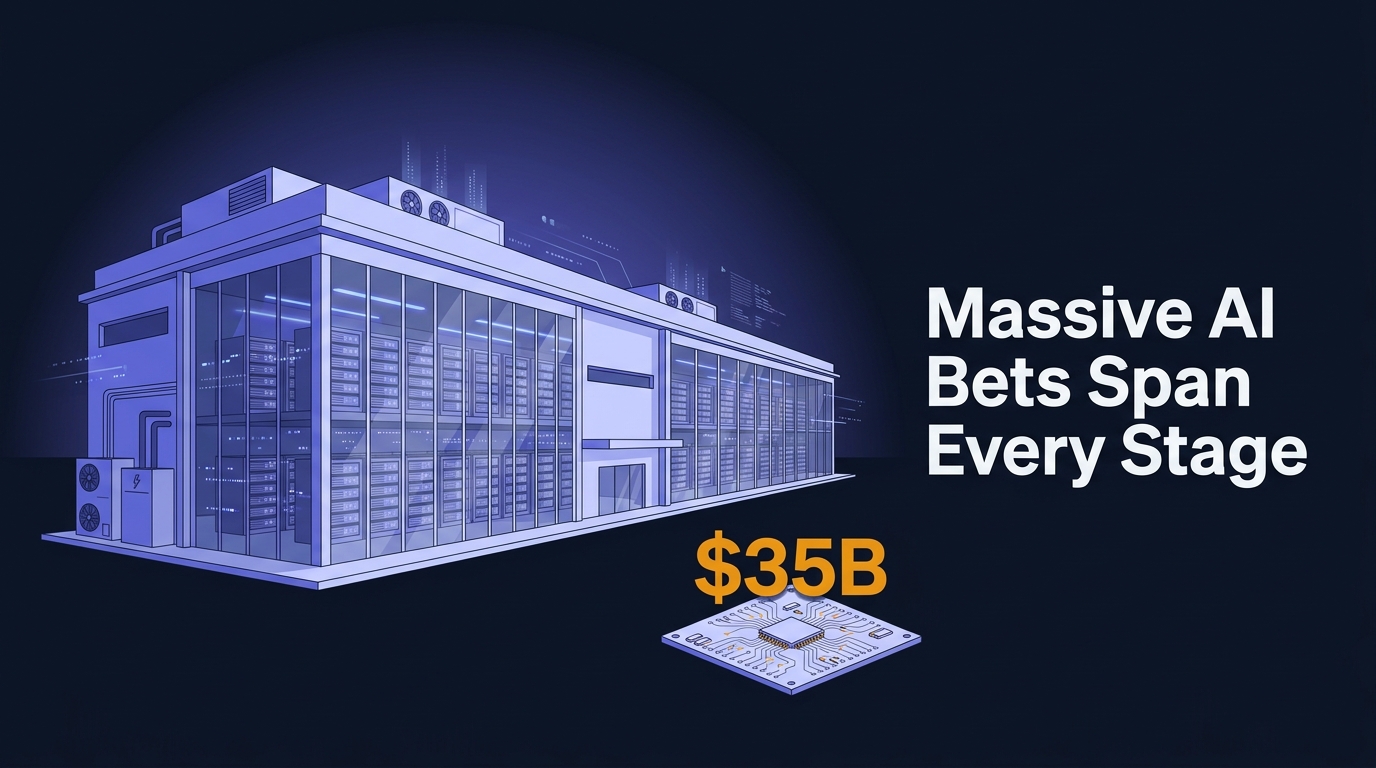
Broadcom, Apollo, and Blackstone announced a $35 billion partnership to expand AI computing capacity, with a focus on next-generation data centers, as reported by CNNBC [4]. Separately, Positron raised $875 million to build inference accelerator chips that run on consumer-grade memory rather than the scarce, expensive high-bandwidth memory that dominates the current chip market, per Die Signal [5].
Together, these two moves describe where the largest pools of capital are heading: physical compute and the components that make it cheaper to run. Positron's approach — sidestepping high-bandwidth memory entirely — is a direct bet that the memory bottleneck in AI inference is solvable with a different hardware architecture. If it works, it could reduce inference costs meaningfully.
For founders raising at the application layer, this infrastructure activity is context rather than competition. More compute capacity and cheaper inference chips eventually translate into lower operating costs for AI products. The timeline for those benefits to reach early-stage companies is uncertain, but the direction of investment is clear.
This week, if you are raising
- If you are raising a seed round with an AI thesis, investors are writing large checks — but the deals getting done pair elite team pedigree with a technically specific, outcome-oriented product narrative, so sharpen both before you start conversations.
- Founders building AI for a high-stakes domain like hardware, biotech, or industrial operations should use Flow Engineering's $750M Series B as a comp when anchoring valuation expectations with investors this quarter [2].
- Monitor inference cost trends closely: Positron's $875M raise targeting consumer-grade memory chips [5] suggests the cost curve for running AI models could shift significantly, which changes the unit economics you should be projecting in your financial model.
Sources
 [1]Hone raises $60M seed to build AI that owns business outcomes | Dealroom Newsdealroom.co
 [2]Flow Engineering Raises $50 Million Series B At $750 Million Valuationpulse2.com
- [3]The maker of non-text AI model Jev valued at $7.5B just weeks after launch | TechCrunchtechcrunch.com
- [4]Broadcom, Apollo and Blackstone Launch $35 Billion Artificial Intelligence Infrastructure Venture - CNNBCcnnbc.com
 [5]Positron raises $875M for inference chips using consumer memory — Die Signaldiesignal.com